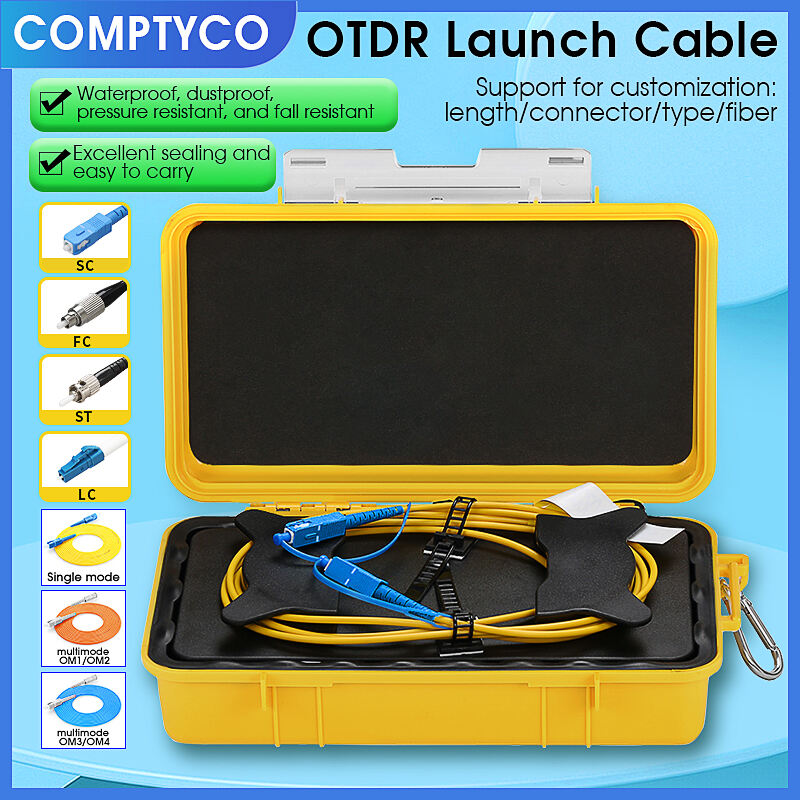
Professional Multimode Fiber Splicing Services - High-Performance Network Solutions

All Categories

multimode fiber splicing

Multimode fiber splicing represents a critical technology in modern telecommunications infrastructure, serving as the foundation for reliable high-speed data transmission across various network environments. This sophisticated process involves permanently joining two or more optical fiber cables to create continuous pathways for light signals, ensuring seamless communication between different network segments. The multimode fiber splicing technique utilizes specialized equipment and precise alignment procedures to fuse fiber cores together, creating joints with minimal signal loss and maximum durability. The primary function of multimode fiber splicing centers on maintaining signal integrity while extending network reach and connectivity options. Unlike single-mode alternatives, multimode configurations support multiple light propagation paths, making them ideal for shorter-distance applications within buildings, campuses, and local area networks. The technological features of multimode fiber splicing include advanced fusion splicers that use electric arcs to meld glass fibers at temperatures exceeding 2000 degrees Celsius. These machines incorporate sophisticated alignment systems, utilizing precise motors and imaging technology to position fibers with sub-micron accuracy before fusion occurs. Modern splicing equipment features automated programs that adjust parameters based on fiber type, ensuring optimal results across different multimode specifications including OM1, OM2, OM3, and OM4 variants. The applications of multimode fiber splicing span numerous industries and environments. Data centers rely heavily on this technology to interconnect servers, switches, and storage systems, supporting bandwidth-intensive operations and cloud computing services. Educational institutions implement multimode fiber splicing for campus-wide networks, connecting dormitories, academic buildings, and administrative facilities. Healthcare organizations utilize these connections for medical imaging systems, electronic health records, and telemedicine applications. Manufacturing facilities depend on multimode fiber splicing for industrial automation, process control systems, and quality monitoring equipment. The technology also serves broadcasting companies for high-definition video transmission and live event coverage.


Popular Products

The advantages of multimode fiber splicing deliver substantial practical benefits that directly impact network performance and operational efficiency for organizations across various sectors. Cost-effectiveness stands as a primary advantage, as multimode fiber splicing requires less expensive equipment compared to single-mode alternatives while providing excellent performance for shorter-distance applications. Organizations can achieve significant savings on both initial installation costs and ongoing maintenance expenses. The splicing process itself proves more forgiving than single-mode procedures, reducing training requirements and allowing technicians to achieve reliable results with less specialized expertise. Multimode fiber splicing supports higher bandwidth capabilities, enabling organizations to transmit large volumes of data simultaneously without degradation. This capacity proves essential for businesses handling video conferencing, cloud computing, and data backup operations. The technology accommodates multiple applications on single fiber strands, maximizing infrastructure utilization and reducing cable management complexity. Installation flexibility represents another key advantage of multimode fiber splicing. The larger core diameter of multimode fibers makes alignment less critical during splicing operations, resulting in faster installation times and reduced labor costs. Technicians can complete splicing tasks more efficiently, minimizing network downtime during maintenance or expansion projects. The robust nature of spliced multimode connections ensures reliable performance in challenging environmental conditions, including temperature fluctuations and mechanical stress. Scalability benefits allow organizations to expand their networks incrementally without replacing existing infrastructure. Multimode fiber splicing enables seamless integration of new equipment and additional connection points as business needs evolve. This adaptability protects technology investments while providing growth opportunities. The standardized nature of multimode fiber splicing ensures compatibility across different manufacturers and equipment types, preventing vendor lock-in situations and providing procurement flexibility. Maintenance advantages include the permanent nature of spliced connections, which eliminate the need for regular connector cleaning and replacement associated with mechanical connections. Spliced joints demonstrate superior resistance to environmental contamination and physical disturbance, resulting in lower failure rates and reduced service calls. The technology supports hot-swappable components in many applications, allowing technicians to perform maintenance without disrupting critical network operations.

Tips And Tricks

Why Choose Comptyco as Your Fiber Optic Solutions Partner?

26

Mar

Why Choose Comptyco as Your Fiber Optic Solutions Partner?

Selecting the right fiber optic solutions partner can significantly impact your project success, operational efficiency, and long-term network reliability. When evaluating potential partners, organizations must consider factors ranging from product q...
View More
Fusion Splicer Maintenance: Essential Care Tips

13

Jan

Fusion Splicer Maintenance: Essential Care Tips

Professional fiber optic installations demand precision equipment that performs consistently under demanding conditions. A fusion splicer represents one of the most critical tools in any technician's arsenal, enabling seamless connections between opt...
View More
Choosing the Right OTDR for Your Network Maintenance and Troubleshooting.

26

Mar

Choosing the Right OTDR for Your Network Maintenance and Troubleshooting.

Selecting the appropriate OTDR for your network infrastructure requires understanding your specific maintenance requirements, network complexity, and troubleshooting objectives. The decision impacts everything from fault detection accuracy to operati...
View More
What Essential Tools Should Be in Every Fiber Technician's Kit?

26

Mar

What Essential Tools Should Be in Every Fiber Technician's Kit?

Every fiber optic technician knows that having the right tools can make the difference between a successful installation and a costly setback. A comprehensive fiber tool kit serves as the foundation for professional fiber optic work, enabling technic...
View More

Get a Free Quote

Our representative will contact you soon.
Email
Name
Company Name
Message
0/1000

multimode fiber splicing

Superior Signal Quality and Minimal Loss Performance

Superior Signal Quality and Minimal Loss Performance

The exceptional signal quality achieved through multimode fiber splicing represents a fundamental advantage that directly impacts network reliability and data transmission efficiency. Professional splicing techniques create fusion joints with typical insertion losses below 0.1 dB, significantly outperforming mechanical connectors that often exhibit losses ranging from 0.3 to 0.75 dB per connection point. This superior performance translates into extended transmission distances and improved signal-to-noise ratios across the entire network infrastructure. The fusion process eliminates air gaps and physical interfaces that commonly cause signal reflections and back-reflections in mechanical connections. By creating a continuous glass pathway, multimode fiber splicing minimizes Fresnel reflections that can degrade signal quality and cause interference in high-speed data applications. This seamless connection proves particularly valuable in applications requiring multiple wavelengths or bidirectional transmission schemes. The splicing process utilizes precise temperature control and timing sequences to ensure optimal fiber core alignment and complete fusion without introducing stress concentrations or geometric irregularities. Advanced splicing equipment incorporates real-time monitoring systems that track splice quality parameters including core alignment, fiber cleave angles, and fusion temperatures. These systems automatically adjust parameters to compensate for variations in fiber characteristics, environmental conditions, and equipment tolerances. The resulting splice joints demonstrate consistent performance across different fiber types and manufacturers, providing network designers with predictable link budgets and reliable system specifications. Quality assurance features built into modern splicers include automated splice loss estimation, which calculates expected performance before completing the fusion process. This capability allows technicians to identify potential issues and make corrections before permanent joint formation, ensuring optimal results and reducing the need for re-splicing operations. The superior signal quality achieved through professional multimode fiber splicing supports higher data rates and more sophisticated modulation schemes, enabling organizations to maximize their network capacity and future-proof their infrastructure investments.
Permanent Weather-Resistant Connections for Long-Term Reliability

Permanent Weather-Resistant Connections for Long-Term Reliability

The permanent and weather-resistant nature of multimode fiber splicing connections provides unmatched reliability advantages that ensure consistent network performance across diverse environmental conditions and extended operational periods. Unlike mechanical connectors that rely on physical contact and precise alignment maintenance, spliced joints create molecularly bonded glass connections that remain stable regardless of temperature variations, humidity changes, or mechanical vibrations. This inherent stability eliminates common failure modes associated with connector contamination, corrosion, and thermal expansion mismatches. Environmental protection capabilities of spliced connections extend far beyond basic weather resistance. The fusion process creates hermetically sealed joints that prevent moisture ingress, dust accumulation, and chemical contamination that frequently affect mechanical connections in outdoor or industrial environments. These sealed connections maintain consistent optical properties even when subjected to extreme temperature cycling, salt spray exposure, or corrosive atmospheric conditions commonly encountered in coastal, industrial, or underground installations. The permanent nature of multimode fiber splicing eliminates the gradual performance degradation often experienced with mechanical connections over time. Mechanical connectors can develop micro-movements, surface wear, and contact pressure variations that progressively increase insertion losses and introduce intermittent connection issues. Spliced joints maintain their initial performance characteristics throughout their operational lifetime, providing predictable network behavior and eliminating unexpected maintenance requirements. Installation versatility allows spliced connections to accommodate challenging routing requirements and space constraints that would be difficult to address with bulky mechanical connectors. The compact profile of splice joints enables installation in tight conduits, underground vaults, and equipment enclosures where connector accessibility proves problematic. This flexibility reduces infrastructure costs and simplifies cable management in complex installations. Long-term cost benefits result from the permanent nature of spliced connections, which eliminate recurring expenses associated with connector replacement, cleaning, and re-termination procedures. Organizations can achieve lower total cost of ownership through reduced maintenance requirements and extended service life compared to networks relying primarily on mechanical connections for critical pathway segments.
Enhanced Network Security and Tamper-Evident Protection

Enhanced Network Security and Tamper-Evident Protection

The security advantages inherent in multimode fiber splicing provide organizations with robust protection against unauthorized access attempts and network tampering that could compromise sensitive data transmission or system integrity. The permanent fusion joint created during the splicing process forms an integral part of the fiber structure that cannot be easily disconnected or intercepted without causing obvious physical damage and complete signal interruption. This tamper-evident characteristic makes spliced connections ideal for secure facilities, government installations, and financial institutions where network security represents a critical operational requirement. Physical security benefits extend beyond simple tamper detection to include protection against sophisticated interception techniques such as fiber bending attacks or micro-bend tapping methods. The solid glass structure of spliced joints resists mechanical manipulation attempts that might successfully extract signals from mechanical connector interfaces or loose fiber sections. Any attempt to access the optical signal requires cutting or significantly disturbing the fiber, which immediately triggers network monitoring systems and alerts security personnel to potential breaches. Network monitoring capabilities integrate seamlessly with spliced fiber infrastructures through optical time-domain reflectometry and other diagnostic techniques that can detect minute changes in fiber characteristics or splice joint performance. These monitoring systems provide continuous surveillance of network integrity, automatically identifying location-specific anomalies that might indicate tampering attempts or equipment failures. The stable baseline characteristics of spliced connections enable more sensitive monitoring thresholds compared to networks with numerous mechanical connectors that exhibit normal performance variations. Installation security advantages include the ability to create concealed splice points within protective enclosures, underground vaults, or building infrastructure where unauthorized access proves extremely difficult. The compact nature of splice joints allows for discrete installation locations that do not advertise network presence or provide obvious access points for potential attackers. This covert deployment capability proves valuable for sensitive applications requiring minimal visibility and maximum protection. Compliance benefits support organizations meeting regulatory requirements for secure communications infrastructure in industries such as healthcare, finance, and government operations. The permanent and verifiable nature of spliced connections provides auditable evidence of network integrity and helps satisfy requirements for secure data handling and transmission. Documentation systems integrated with professional splicing equipment create detailed records of splice locations, performance characteristics, and installation personnel, supporting comprehensive security auditing and maintenance tracking requirements.
Professional Multimode Fiber Splicing Services - High-Performance Network Solutions Professional Multimode Fiber Splicing Services - High-Performance Network Solutions Professional Multimode Fiber Splicing Services - High-Performance Network Solutions Professional Multimode Fiber Splicing Services - High-Performance Network Solutions
Professional Multimode Fiber Splicing Services - High-Performance Network Solutions