 EN
EN
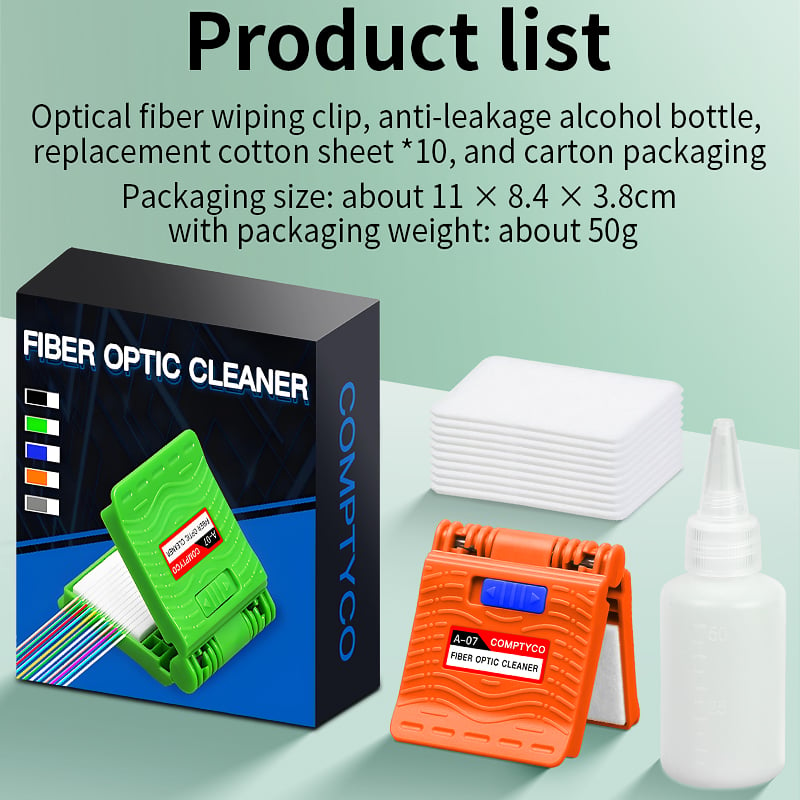
Contaminated fiber optic ports are one of the leading causes of signal loss, network downtime, and costly equipment failures in both enterprise and industrial environments. When dust, oil, or microscopic debris settle inside a connector or adapter, the degradation can be immediate and severe. A fiber cleaning clip is designed specifically to address this problem by securing and guiding the cleaning process at the port level, making contamination control more reliable and repeatable.

The short answer is yes — a fiber cleaning clip can meaningfully reduce failures caused by contaminated ports, but only when used correctly and consistently. Understanding how contamination actually enters ports, what role the fiber cleaning clip plays in the cleaning workflow, and when it provides the most value will help network engineers and technicians make better decisions about their maintenance routines. This article examines those questions in practical detail.
How Port Contamination Leads to Network Failures
The Mechanism of Fiber Port Contamination
Fiber optic connectors operate at tolerances measured in microns. Even a small particle resting on the end-face of a ferrule can scatter or absorb light, reducing signal quality significantly. Contamination typically enters ports through repeated mating and unmating cycles, airborne particulates in data center environments, handling without proper tools, and ports left uncapped during installation or maintenance. Each of these scenarios introduces a risk that the fiber cleaning clip is engineered to help manage. Using a fiber cleaning clip as part of a disciplined inspection-and-clean protocol is one of the most direct responses to these contamination vectors.
Why Contamination Is Often Underestimated
Many technicians underestimate contamination risk because degradation is not always visible to the naked eye. A port may look clean but still carry oils from fingerprint contact or residue from a previous cleaning attempt that used an inappropriate tool. This is precisely where the fiber cleaning clip adds value — it provides a controlled interface that reduces the chance of recontamination during the cleaning motion itself. Without a fiber cleaning clip, even a technically correct cleaning stroke can drag debris back across the ferrule end-face, negating the effort entirely.
What a Fiber Cleaning Clip Actually Does
The Functional Role of a Fiber Cleaning Clip
A fiber cleaning clip is a precision accessory that holds the cleaning tape or ribbon in proper alignment as it passes across the ferrule end-face. By securing the cleaning medium at a fixed angle and applying consistent pressure, the fiber cleaning clip ensures that each cleaning stroke removes contamination uniformly rather than redistributing it. This is a critical distinction. Inconsistent pressure or misaligned contact is a common reason why manual cleaning attempts fail or make contamination worse. The fiber cleaning clip eliminates much of that variability, especially in field conditions where technician fatigue or awkward angles would otherwise compromise the result.
Integration with Cleaning Tools and Workflows
A fiber cleaning clip is typically used in conjunction with a reel-based cleaning tool or a one-click cleaning pen, depending on the connector type and port configuration. For adapters mounted in patch panels or switches, the fiber cleaning clip guides the cleaning element into the port without the user needing to visually confirm alignment each time. This makes the fiber cleaning clip particularly useful in high-density installations where ports are closely spaced and difficult to access. The fiber cleaning clip does not replace inspection — a fiber optic microscope or video inspection probe should always be used before and after cleaning — but it substantially improves the reliability of the cleaning step itself.
When a Fiber Cleaning Clip Provides the Most Value
High-Density and High-Traffic Environments
In data centers, telecom exchanges, and industrial automation systems where hundreds or thousands of fiber connections are maintained on a regular basis, the fiber cleaning clip delivers compounding value. When each technician on a team uses a fiber cleaning clip consistently, the variability in cleaning outcomes decreases across the board. This is important because contamination-related failures in high-density environments are rarely isolated — a single dirty port can affect multiple downstream connections, especially in MPO or MTP array configurations. The fiber cleaning clip helps standardize cleaning quality at scale, which directly reduces the frequency of port-related failures.
Preventive Maintenance Versus Reactive Repair
The fiber cleaning clip delivers its greatest return when it is part of a preventive maintenance program rather than a reactive repair response. When technicians reach for a fiber cleaning clip only after a failure has been reported, the contamination may already have caused measurable damage to the ferrule end-face or the connected equipment. Incorporating the fiber cleaning clip into every scheduled port inspection — even when no failure is suspected — is a low-cost, high-impact practice. The fiber cleaning clip is a small tool with a significant role in keeping port end-faces within acceptable cleanliness standards, which translates directly into fewer unplanned outages and lower long-term maintenance costs.
Training and Standardization Across Teams
Another scenario where the fiber cleaning clip proves especially valuable is during onboarding of new technicians or when standardizing practices across multiple sites. Because the fiber cleaning clip guides the physical interaction between the cleaning medium and the ferrule, it reduces dependence on individual skill level. A new technician using a fiber cleaning clip correctly will achieve more consistent results than an experienced technician cleaning without one under suboptimal conditions. For organizations managing fiber infrastructure across distributed locations, issuing a fiber cleaning clip as a standard part of every technician's toolkit is a straightforward way to raise the floor on cleaning quality network-wide.
FAQ
Does a fiber cleaning clip work with all connector types?
Most fiber cleaning clip designs are compatible with common connector formats such as LC, SC, and ST, but compatibility with MPO or specialty connectors may require a specific variant. Always verify that the fiber cleaning clip you select matches the ferrule diameter and port geometry of your target connectors before use.
How often should a fiber cleaning clip be used during maintenance?
A fiber cleaning clip should be used every time a port is cleaned, regardless of whether visible contamination is present. Industry best practice recommends cleaning any port before it is mated or remated. Incorporating the fiber cleaning clip into every cleaning event — not just when problems are suspected — is the most effective way to prevent contamination-related failures.
Can a fiber cleaning clip replace visual inspection tools?
No. A fiber cleaning clip improves the consistency and quality of the cleaning process, but it does not replace inspection. A video inspection probe or fiber optic microscope should be used before and after each cleaning cycle to confirm that contamination has been fully removed. The fiber cleaning clip and inspection tools work together as complementary parts of a complete port maintenance routine.