
 EN
EN
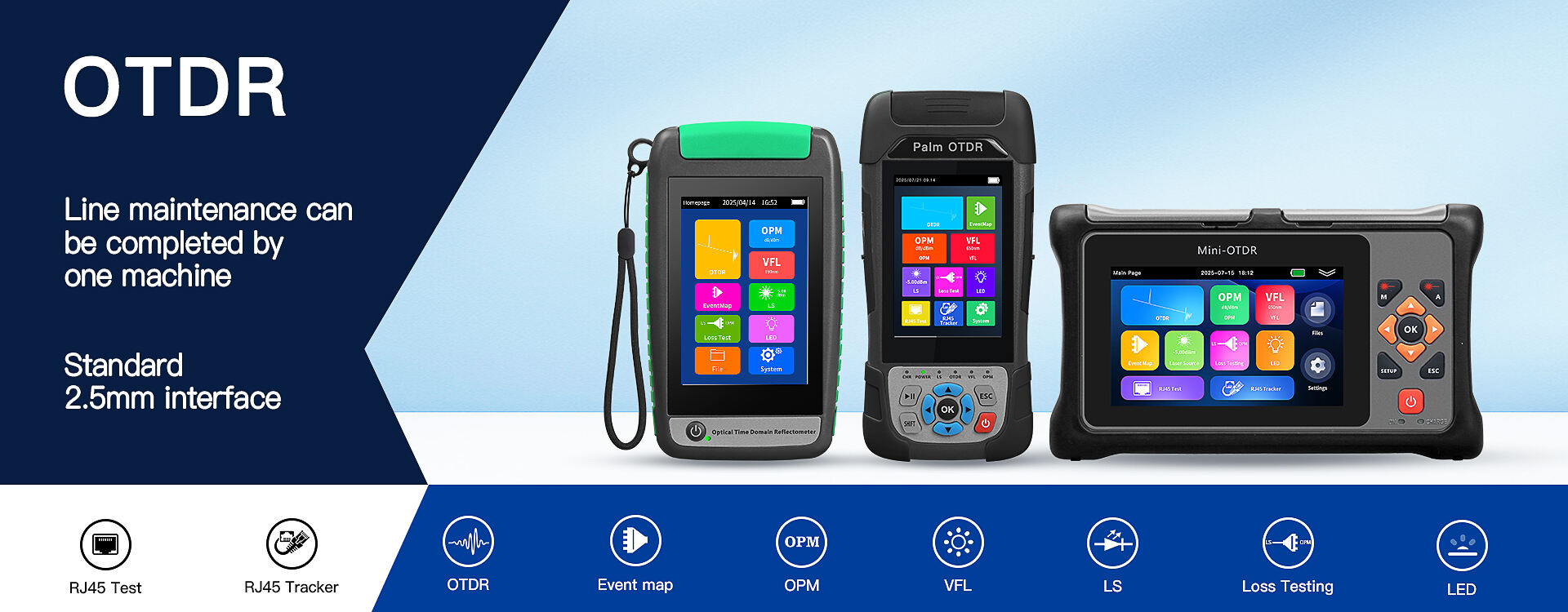
In today's rapidly advancing era of optical fiber communications, Optical Time Domain Reflectometers (OTDRs) have become indispensable precision instruments for the construction, maintenance, and fault diagnosis of fiber optic networks. With the maturation of next-generation OTDR technology in 2025, device performance has reached unprecedented levels. This guide will provide an in-depth analysis of OTDR working principles, core technical parameters, and comprehensive purchasing and application guidance based on Comptyco's latest product line.
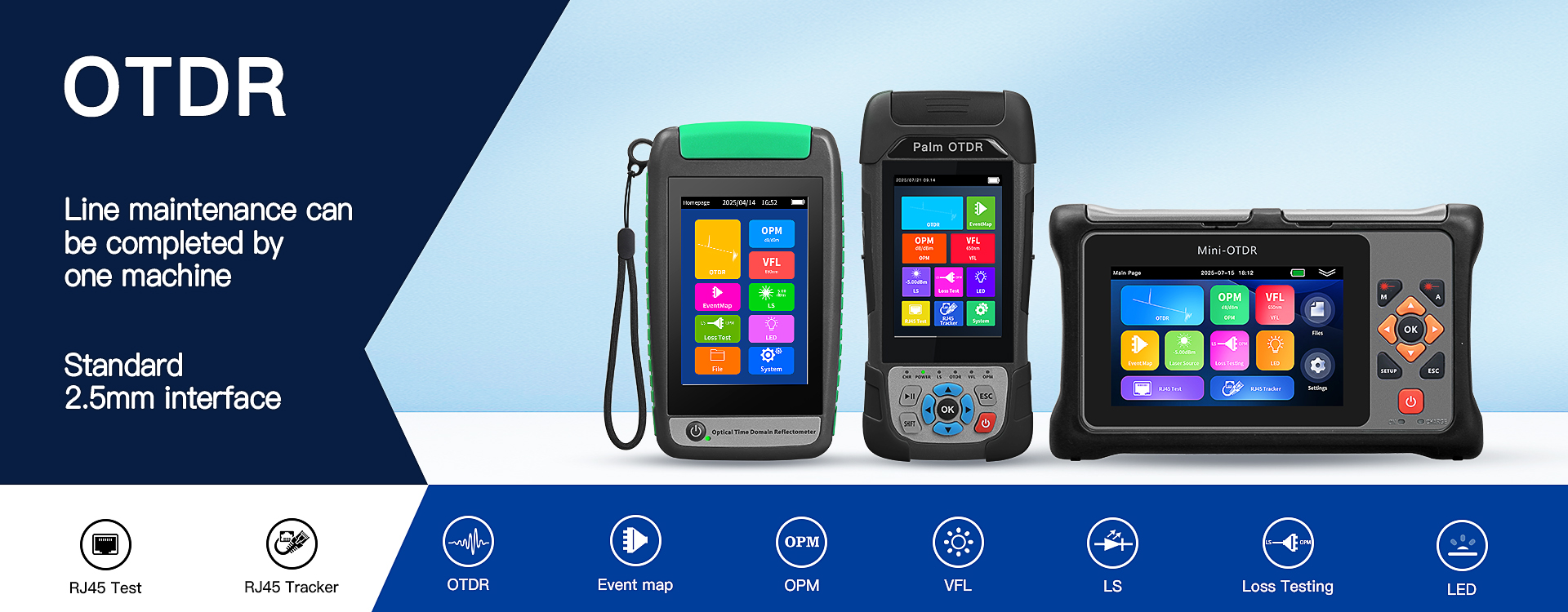
Part 1: OTDR Technical Fundamentals: From Principles to Applications
1.1 In-Depth Analysis of Working Principles
An OTDR precisely measures the characteristics of a fiber optic link by injecting light pulses into the fiber and then detecting and analyzing the backscattered and reflected light signals. Its working principle involves three key processes:
Pulse Emission and Reception
The laser source emits nanosecond-level light pulses at specific wavelengths (typically 1310nm, 1550nm, 1625nm)
A high-sensitivity detector receives the returned Rayleigh scattering and Fresnel reflection signals
Precise timing measures the round-trip time of the optical signal to calculate the distance to a fault point
Signal Analysis and Processing
Modern OTDRs use advanced digital signal processing algorithms
Automatic identification of event points (connectors, splice points, bends, etc.)
Intelligent differentiation between different types of fiber events and faults
Data Visualization and Reporting
Real-time display of attenuation curves and event tables
Support for multi-language interfaces and various export formats
Integration of GPS positioning and project management systems
1.2 Analysis of Core OTDR Performance Metrics
Dynamic Range
Definition: The difference between the maximum and minimum power the OTDR can detect.
Importance: Determines the maximum testing distance of the device.
KP600: 22dB (90km testing capability)
KP800: 22dB (100km testing capability)
AUA-18U/A: 22dB (80km testing capability)
Dead Zone
Event Dead Zone: 10-15 meters (excellent indicator)
Attenuation Dead Zone: 30-50 meters (excellent indicator)
Practical Impact: Smaller dead zones enable more accurate testing of short-distance fibers.
Wavelength Selection
1310nm: Multimode fiber and short-distance single-mode testing.
1550nm: Standard single-mode fiber loss testing.
1625nm: In-service testing (without interrupting traffic).
Dual-wavelength testing: Testing at both 1310nm and 1550nm simultaneously to improve fault diagnosis accuracy.
Part 2: In-Depth Comparison of Comptyco's 2025 OTDR Product Line
2.1 KP600: Cost-Effective Professional Solution
Highlights of Technical Specifications
Testing Distance: 90km, meeting most metropolitan area network requirements.
Dynamic Range: 28dB @1550nm.
Event Dead Zone: <3 meters.
Interface Type: UPC/APC switchable.
Battery Life: 8 hours of continuous operation.
Display Screen: 5-inch high-definition touchscreen.
Application Scenarios
Small to medium-sized network maintenance teams.
FTTx deployment and acceptance testing.
Educational institutions and training centers.
Budget-conscious users with professional needs.
Unique Advantages
The KP600 excels in cost-effectiveness. Its 90km testing distance and 3-meter event dead zone are sufficient for most metropolitan access networks and local area network testing. The device weighs only 1.5kg, making it ideal for field technicians who need to move frequently.
2.2 KP800: High-Performance Professional Testing Platform
Highlights of Technical Specifications
Testing Distance: 100km, supporting ultra-long-distance backbone networks.
Dynamic Range: 32dB @1550nm, industry-leading level.
Wavelength Configuration: Dual-wavelength standard configuration (1310/1550nm).
Sampling Points: Up to 256,000 points.
Data Storage: 32GB internal storage + cloud synchronization.
Smart Features: AI-assisted fault diagnosis.
Application Scenarios
Telecom operator backbone network maintenance.
Large-scale data center interconnect testing.
Submarine cable testing and monitoring.
Third-party testing agencies with high demands.
Technological Innovation
The KP800 introduces an artificial intelligence-assisted diagnostic system capable of automatically identifying over 95% of common fault types and providing repair recommendations. Its 100km testing capability combined with a 32dB dynamic range enables accurate diagnosis of minute loss variations on ultra-long-distance links.
2.3 AUA-18U/A: 7-in-1 Multi-functional Intelligent OTDR
Revolutionary Design Concept
The AUA-18U/A represents a new direction in OTDR technology development—integration and intelligence. This device is not just an OTDR; it's a complete fiber optic testing platform.
Seven Integrated Functions
OTDR Function: 80km testing distance, 30dB dynamic range.
Optical Power Meter (OPM): -70 to +26 dBm measurement range.
Stable Light Source: Dual-wavelength output at 1310/1550nm.
Fiber Identifier: Non-destructive identification of live fibers.
Visual Fault Locator (VFL): 30km red light fault location.
Fiber Inspection Probe: 200x magnification inspection.
Optical Loss Test Set (OLTS): Automatic bi-directional testing.
Technological Breakthroughs
Full Touch Operation: 7-inch high-definition touchscreen with an intuitive interface.
Smart Recognition: Automatic identification of fiber type and connector type.
One-Button Testing: Automatically optimizes test parameters, simplifying operation.
Real-time Analysis: Displays results and suggestions in real-time during testing.
Application Value
For field engineers who frequently need to switch between different testing functions, the AUA-18U/A significantly improves work efficiency. One device can complete the entire workflow from end-face inspection to link testing, reducing the amount of equipment to carry and test preparation time.
Part 3: OTDR Purchasing Decision Guide
3.1 Demand Analysis and Scenario Matching
Network Type Determines Testing Requirements
Access Network/FTTH: The KP600 is sufficient.
Metro Network/Enterprise Network: The KP800 provides higher precision.
Mixed Environments/Multi-functional Needs: The AUA-18U/A is the best choice.
Frequency of Use and Team Size
Individuals or small teams: Consider multi-function all-in-one machines.
Large teams: Can choose specialized equipment based on division of labor.
High-frequency use: Prioritize durability and battery life.
3.2 Key Points for Selecting Technical Parameters
Dynamic Range Selection
Access Network: 26-28dB is sufficient.
Backbone Network: Requires 30dB or above.
Long-distance/Complex Links: 32dB or higher.
Dead Zone Considerations
Data Centers/Short-distance Dense Connections: Require minimal dead zones.
Long-haul Trunks: Dead zone requirements are relatively relaxed.
Wavelength Configuration
Basic Maintenance: Single wavelength is sufficient.
Professional Testing: Dual wavelengths are necessary.
In-service Monitoring: Requires 1625nm wavelength.
3.3 Budget and Return on Investment Analysis
Initial Investment Comparison
KP600: The most cost-effective professional choice.
KP800: High-performance investment with significant long-term value.
AUA-18U/A: Multi-functional investment, saving costs on multiple device purchases.
Operational Cost Considerations
Consumables and calibration costs.
Software upgrades and technical support.
Training costs and learning curve.
Return on Investment Calculation
Time value gained from improved testing efficiency.
Cost savings from reducing misjudgments and rework.
Long-term value from extended equipment lifespan.
Part 4: OTDR Best Practices and Advanced Techniques
4.1 Optimized Test Parameter Settings
Pulse Width Selection
Short Pulse (10-100ns): Short distance, high resolution.
Medium Pulse (100ns-1μs): Medium distance, balanced resolution.
Long Pulse (1-10μs): Long distance, low resolution.
Averaging Time Optimization
Short-distance Testing: 30-second average is sufficient.
Long-distance Testing: Requires 2-3 minute average.
High-quality Testing: Use intelligent averaging technology.
4.2 Testing Strategies for Complex Environments
Multi-branch Network Testing
Use different wavelengths for segmented testing.
Properly set refractive index and scattering coefficient.
Use bi-directional averaging to improve accuracy.
High-loss Link Testing
Select appropriate pulse width.
Increase averaging time.
Use devices with higher dynamic range.
4.3 Data Management and Report Generation
Standardized Testing Processes
Establish unified test templates.
Standardize naming and storage rules.
Implement quality check procedures.
Intelligent Reporting System
Automatically generate reports that comply with industry standards.
Integrate GIS (Geographic Information System).
Support cloud synchronization and team collaboration.
Part 5: OTDR Technology Development Trends in 2025
5.1 Intelligence and Automation
AI-assisted fault diagnosis and prediction.
Automatic parameter optimization and test planning.
Intelligent report generation and analysis.
5.2 Integration and Multi-functionality
Integration of more testing functions.
Modular design supporting function expansion.
Wireless connectivity and remote control.
5.3 High Precision and High Efficiency
Higher sampling rates and resolution.
Faster testing speeds.
Longer battery life.
Part 6: Summary of the Purchasing Decision Process
Needs Assessment: Clarify testing distance, precision requirements, and usage scenarios.
Budget Planning: Balance initial investment with long-term operational costs.
Feature Comparison: Select necessary features based on actual needs.
Performance Verification: Reference third-party tests and user reviews.
Supplier Evaluation: Consider technical support, training, and after-sales service.
Trial Validation: Test device performance in real-world environments.
Conclusion: A Future-Oriented Investment Decision
Choosing an OTDR device in 2025 is not just about purchasing a testing tool; it is an investment in reliable assurance for your fiber optic network. Comptyco's three products—KP600, KP800, and AUA-18U/A—represent excellent solutions in three different dimensions: cost-effectiveness, high performance, and multi-functionality.
Core Recommendations:
For users seeking the best cost-effectiveness, the KP600 offers a balance of professional testing capability and reasonable price.
For professional teams requiring peak performance, the KP800's ultra-long testing distance and high dynamic range are the ideal choice.
For field engineers looking to maximize equipment utilization, the AUA-18U/A's 7-in-1 functionality provides unparalleled convenience.
Today, driven by 5G, IoT, and cloud computing, fiber optic networks are developing rapidly. An excellent OTDR is not only a tool for fault diagnosis but also a guardian of network quality assurance. A wise choice will bring long-term efficiency improvements and quality assurance to your network construction and maintenance work.
Table of Contents
- Part 1: OTDR Technical Fundamentals: From Principles to Applications
- Part 2: In-Depth Comparison of Comptyco's 2025 OTDR Product Line
- Part 3: OTDR Purchasing Decision Guide
- Part 4: OTDR Best Practices and Advanced Techniques
- Part 5: OTDR Technology Development Trends in 2025
- Part 6: Summary of the Purchasing Decision Process
- Conclusion: A Future-Oriented Investment Decision