
 EN
EN
Selecting the perfect fusion splicer for your fiber optic project is one of the most critical decisions your team will make. With options ranging from $2,000 to over $20,000, understanding your specific needs and matching them to the right equipment can mean the difference between project success and costly delays. This comprehensive guide analyzes four industry-leading models from Comptyco to help you make an informed decision that aligns with your technical requirements, budget constraints, and operational environment.
Understanding Your Project Requirements: The Foundation of Selection
Before comparing specific models, clearly define your project parameters:
1. Project Type & Scale
FTTH Deployments: High-volume, repetitive splicing in various environments
Telecom Backbone Networks: Critical infrastructure requiring maximum precision
Enterprise Networks: Mixed fiber types and occasional splicing needs
Emergency Restoration: Rapid response in challenging conditions
Specialized Applications: Military, aerospace, or underwater applications
2. Required Technical Specifications
Target Splice Loss: <0.02dB for backbone networks, <0.05dB for distribution networks
Fiber Types: Single-mode, multimode, or specialty fibers
Splicing Speed: Capacity requirements and turnaround expectations
Environmental Conditions: Indoor, outdoor, extreme temperatures
3. Team & Operational Factors
Operator Experience Level: Novice-friendly vs. expert-oriented interfaces
Maintenance Capabilities: In-house technical support vs. vendor dependency
Budget Constraints: Initial investment vs. total cost of ownership
The Four Contenders: Detailed Model Analysis
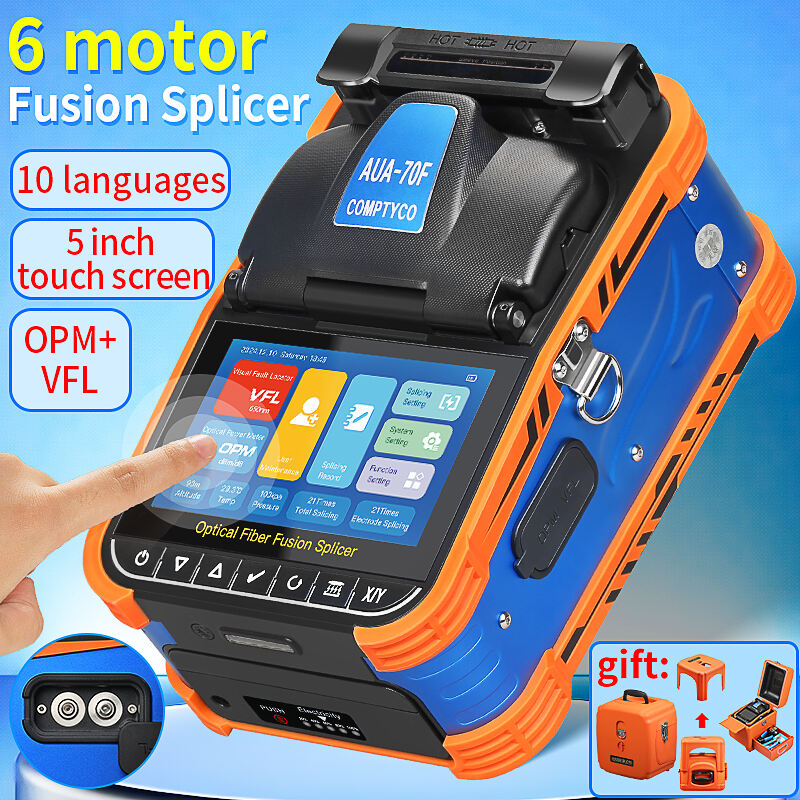
1. Comptyco AUA-70F: The Precision Powerhouse
Best For: Mission-critical backbone networks, laboratory environments, and projects demanding uncompromising quality.
Key Strengths:
6-Motor Precision Alignment System: Achieves consistent splice losses below 0.02dB, crucial for long-distance networks
Fully Automatic Operation: Reduces operator dependency and training requirements
Integrated OPM and VFL: Complete workstation functionality in a single device
5-Inch Touchscreen Interface: Intuitive operation with detailed visual feedback
Technical Edge:
The AUA-70F's fully automatic alignment system represents the pinnacle of splicing technology. Its six independent motors provide micron-level precision across all axes, ensuring perfect core alignment regardless of fiber condition. The integrated optical power meter allows immediate loss verification without additional equipment—a crucial feature for high-stakes projects where every decibel counts.
Investment Rationale:
While commanding a premium price, the AUA-70F delivers exceptional value through reduced training time, minimized rework, and enhanced productivity. For projects where splice quality directly impacts network performance and customer service level agreements (SLAs), this investment pays dividends through reliability and reduced operational risk.
2. Comptyco L-90C: The Versatile Performer
Best For: Multinational projects, mixed-environment operations, and teams requiring maximum flexibility.
Key Strengths:
Dual Operation Interface: Touchscreen and physical buttons adapt to any working condition
10-Language Support: Essential for international teams and projects
Flip-Style Fiber Holder: Streamlines loading process and improves ergonomics
Robust 6-Motor System: Maintains high precision despite environmental challenges
Operational Excellence:
The L-90C's defining feature is its adaptability. The dual-operation interface proves invaluable when technicians work in direct sunlight where touchscreens become difficult to use, or in cold conditions where gloves are necessary. The flip-style holder significantly reduces fiber loading time—a small innovation that saves seconds per splice, accumulating to hours saved on large projects.
Global Project Advantage:
For organizations working across borders, the 10-language interface eliminates training barriers and reduces operational errors. This model serves as a "versatile performer" that performs consistently whether deployed in Scandinavian winters, Middle Eastern heat, or tropical humidity.
3. Comptyco A-5: The Balanced Workhorse
Best For: Small to medium-sized contractors, budget-conscious organizations, and high-volume FTTH deployments.
Key Strengths:
Exceptional Battery Life: 7800mAh capacity supports extended field operations
Integrated Testing Suite: OPM and VFL included at an accessible price point
Touchscreen Simplicity: Modern interface without excessive complexity
Proven Reliability: Consistent performance in demanding field conditions
Value Proposition:
The A-5 strikes an optimal balance between performance and affordability. Its 7800mAh battery delivers approximately 300+ splices per charge—eliminating midday charging breaks that disrupt workflow on large FTTH projects. The inclusion of both OPM and VFL means technicians can verify their work immediately without carrying additional test equipment.
Operational Efficiency:
For contractors operating on tight margins, the A-5 reduces both initial investment and ongoing operational costs. Its simplicity minimizes training time, while its reliability reduces maintenance expenses and project delays. This model represents the "sweet spot" for organizations that need professional-grade performance without enterprise-level investment.
4. Comptyco FS-60E: The Rugged Specialist
Best For: Emergency restoration, harsh environment operations, and utility company field crews.
Key Strengths:
Dual Operation Reliability: Functions in extreme conditions where touchscreens fail
Built-in Light Source: Integrated red light for continuity testing
6700mAh High-Capacity Battery: Extended operation in remote locations
Rugged Construction: Designed to withstand field abuse and environmental extremes
Environmental Mastery:
The FS-60E excels where other splicers struggle. Its physical button interface remains operable with gloves on, in pouring rain, or in sub-freezing temperatures where touchscreens become unresponsive. The integrated red light source provides immediate fiber tracing capability—essential during emergency restoration when every minute counts.
Durability Advantage:
Constructed to withstand the rigors of field work, the FS-60E tolerates vibration, dust, moisture, and temperature extremes that would compromise less robust equipment. For utility crews working from bucket trucks or in manholes, this durability translates directly to equipment longevity and reduced downtime.
Decision Matrix: Matching Models to Project Types
| Project Characteristics | Recommended Model | Key Rationale |
|---|---|---|
| Long-Distance Telecom Backbone Networks | AUA-70F | Maximum precision and lowest loss requirements |
| International Deployment | L-90C | Language support and environmental adaptability |
| High-Volume FTTH Large-Scale Deployment | A-5 | Battery life and operational efficiency |
| Urban FTTx Deployment | L-90C or A-5 | Balance of precision and productivity |
| Emergency Restoration | FS-60E | Ruggedness and reliability in harsh conditions |
| Military/Specialized Projects | FS-60E | Extreme environment capability |
| Small Contractor/Mixed Projects | A-5 | Best value and versatility |
| Training/Educational Use | A-5 or L-90C | Cost-effectiveness and learning features |
Total Cost of Ownership Analysis
Initial Investment vs. Long-Term Value Comparison
AUA-70F: Higher initial cost offset by reduced training time, minimized rework, and highest productivity
L-90C: Moderate premium justified by its versatility, reduced project delays, and global usability
A-5: Optimal balance with the lowest total cost of ownership for typical field operations
FS-60E: Specialized investment that prevents equipment failure in critical situations
Hidden Costs to Consider
Training Time: AUA-70F requires the least training; FS-60E is most adaptable to existing skills
Accessory Requirements: Models without integrated OPM and VFL require additional equipment investment
Battery Replacements: Higher capacity batteries (A-5, FS-60E) have longer service life
Downtime Impact: Equipment failure during critical projects carries exponential costs
Ensuring Your Investment is Future-Proof
Technological Obsolescence Considerations
Software Updates: All Comptyco models receive regular firmware updates
Fiber Type Compatibility: Ensure support for emerging fiber standards
Connectivity Features: Consider future integration with network management systems
Scalability Factors
Growing Team Needs: L-90C supports operators at different skill levels
Expanding Project Types: AUA-70F handles the widest range of technical challenges
Geographic Expansion: L-90C's multilingual support facilitates international growth
Implementation Strategy: Phased Approach
For Organizations with Diverse Needs
Start with A-5 for general field operations and training
Add AUA-70F for projects with extremely high precision requirements
Introduce FS-60E for specialized harsh environment work
Standardize on L-90C for international or mixed-environment teams
Budget Allocation Guidelines
Small Businesses: Allocate 60-70% of budget to equipment, 30-40% to training and accessories
Enterprise Teams: Consider equipment pools with mixed models for different use cases
Government/Utility: Prioritize durability and lifecycle costs over initial price
Verification and Confirmation Process
Before Final Decision
Hands-On Testing: Request demonstration units for field evaluation
Reference Investigation: Contact existing users with similar applications
Total Cost Analysis: Calculate 3-year ownership costs including maintenance
Training Assessment: Evaluate the learning curve for your specific team
Negotiation Points with Suppliers
Bundled Pricing: Combine multiple devices with accessories
Service Agreements: Negotiate extended warranty periods and response times
Training Packages: Include comprehensive operator and maintenance training
Future Upgrade Options: Secure favorable terms for technology updates
Conclusion: Strategic Investment for Project Success
Choosing the right fusion splicer is more than just simple equipment selection—it represents a strategic decision that impacts project timelines, quality outcomes, and operational efficiency. The four Comptyco models studied each excel in specific scenarios:
Choose AUA-70F when precision is non-negotiable and budgets support premium investment
Select L-90C for versatile operations across diverse environments and teams
Opt for A-5 when balancing professional capability with budgetary reality
Deploy FS-60E when reliability in challenging conditions determines project success
The most expensive splicer isn't necessarily the $20,000 model you rarely use, but rather the $5,000 unit that fails during a critical project or forces unacceptable compromises in network quality. Conversely, over-investing in capabilities you'll never use represents inefficient capital allocation.
By carefully analyzing your specific project requirements, operational environment, team capabilities, and growth trajectory against the distinct strengths of these four exceptional models, you can make a selection that delivers optimal value throughout its service life. In the rapidly evolving world of fiber optics, the right equipment choice today builds the foundation for project success tomorrow.
Selecting the perfect fusion splicer for your fiber optic project is one of the most critical decisions your team will make. With options ranging from $2,000 to over $20,000, understanding your specific needs and matching them to the right equipment can mean the difference between project success and costly delays. This comprehensive guide analyzes four industry-leading models from Comptyco to help you make an informed decision that aligns with your technical requirements, budget constraints, and operational environment.
Understanding Your Project Requirements: The Foundation of Selection
Before comparing specific models, clearly define your project parameters:
1. Project Type & Scale
FTTH Deployments: High-volume, repetitive splicing in various environments
Telecom Backbone Networks: Critical infrastructure requiring maximum precision
Enterprise Networks: Mixed fiber types and occasional splicing needs
Emergency Restoration: Rapid response in challenging conditions
Specialized Applications: Military, aerospace, or underwater applications
2. Required Technical Specifications
Target Splice Loss: <0.02dB for backbone networks, <0.05dB for distribution networks
Fiber Types: Single-mode, multimode, or specialty fibers
Splicing Speed: Capacity requirements and turnaround expectations
Environmental Conditions: Indoor, outdoor, extreme temperatures
3. Team & Operational Factors
Operator Experience Level: Novice-friendly vs. expert-oriented interfaces
Maintenance Capabilities: In-house technical support vs. vendor dependency
Budget Constraints: Initial investment vs. total cost of ownership
The Four Contenders: Detailed Model Analysis
1. Comptyco AUA-70F: The Precision Powerhouse
Best For: Mission-critical backbone networks, laboratory environments, and projects demanding uncompromising quality.
Key Strengths:
6-Motor Precision Alignment System: Achieves consistent splice losses below 0.02dB, crucial for long-distance networks
Fully Automatic Operation: Reduces operator dependency and training requirements
Integrated OPM and VFL: Complete workstation functionality in a single device
5-Inch Touchscreen Interface: Intuitive operation with detailed visual feedback
Technical Edge:
The AUA-70F's fully automatic alignment system represents the pinnacle of splicing technology. Its six independent motors provide micron-level precision across all axes, ensuring perfect core alignment regardless of fiber condition. The integrated optical power meter allows immediate loss verification without additional equipment—a crucial feature for high-stakes projects where every decibel counts.
Investment Rationale:
While commanding a premium price, the AUA-70F delivers exceptional value through reduced training time, minimized rework, and enhanced productivity. For projects where splice quality directly impacts network performance and customer service level agreements (SLAs), this investment pays dividends through reliability and reduced operational risk.
2. Comptyco L-90C: The Versatile Performer
Best For: Multinational projects, mixed-environment operations, and teams requiring maximum flexibility.
Key Strengths:
Dual Operation Interface: Touchscreen and physical buttons adapt to any working condition
10-Language Support: Essential for international teams and projects
Flip-Style Fiber Holder: Streamlines loading process and improves ergonomics
Robust 6-Motor System: Maintains high precision despite environmental challenges
Operational Excellence:
The L-90C's defining feature is its adaptability. The dual-operation interface proves invaluable when technicians work in direct sunlight where touchscreens become difficult to use, or in cold conditions where gloves are necessary. The flip-style holder significantly reduces fiber loading time—a small innovation that saves seconds per splice, accumulating to hours saved on large projects.
Global Project Advantage:
For organizations working across borders, the 10-language interface eliminates training barriers and reduces operational errors. This model serves as a "versatile performer" that performs consistently whether deployed in Scandinavian winters, Middle Eastern heat, or tropical humidity.
3. Comptyco A-5: The Balanced Workhorse
Best For: Small to medium-sized contractors, budget-conscious organizations, and high-volume FTTH deployments.
Key Strengths:
Exceptional Battery Life: 7800mAh capacity supports extended field operations
Integrated Testing Suite: OPM and VFL included at an accessible price point
Touchscreen Simplicity: Modern interface without excessive complexity
Proven Reliability: Consistent performance in demanding field conditions
Value Proposition:
The A-5 strikes an optimal balance between performance and affordability. Its 7800mAh battery delivers approximately 300+ splices per charge—eliminating midday charging breaks that disrupt workflow on large FTTH projects. The inclusion of both OPM and VFL means technicians can verify their work immediately without carrying additional test equipment.
Operational Efficiency:
For contractors operating on tight margins, the A-5 reduces both initial investment and ongoing operational costs. Its simplicity minimizes training time, while its reliability reduces maintenance expenses and project delays. This model represents the "sweet spot" for organizations that need professional-grade performance without enterprise-level investment.
4. Comptyco FS-60E: The Rugged Specialist
Best For: Emergency restoration, harsh environment operations, and utility company field crews.
Key Strengths:
Dual Operation Reliability: Functions in extreme conditions where touchscreens fail
Built-in Light Source: Integrated red light for continuity testing
6700mAh High-Capacity Battery: Extended operation in remote locations
Rugged Construction: Designed to withstand field abuse and environmental extremes
Environmental Mastery:
The FS-60E excels where other splicers struggle. Its physical button interface remains operable with gloves on, in pouring rain, or in sub-freezing temperatures where touchscreens become unresponsive. The integrated red light source provides immediate fiber tracing capability—essential during emergency restoration when every minute counts.
Durability Advantage:
Constructed to withstand the rigors of field work, the FS-60E tolerates vibration, dust, moisture, and temperature extremes that would compromise less robust equipment. For utility crews working from bucket trucks or in manholes, this durability translates directly to equipment longevity and reduced downtime.
Decision Matrix: Matching Models to Project Types
| Project Characteristics | Recommended Model | Key Rationale |
|---|---|---|
| Long-Distance Telecom Backbone Networks | AUA-70F | Maximum precision and lowest loss requirements |
| International Deployment | L-90C | Language support and environmental adaptability |
| High-Volume FTTH Large-Scale Deployment | A-5 | Battery life and operational efficiency |
| Urban FTTx Deployment | L-90C or A-5 | Balance of precision and productivity |
| Emergency Restoration | FS-60E | Ruggedness and reliability in harsh conditions |
| Military/Specialized Projects | FS-60E | Extreme environment capability |
| Small Contractor/Mixed Projects | A-5 | Best value and versatility |
| Training/Educational Use | A-5 or L-90C | Cost-effectiveness and learning features |
Total Cost of Ownership Analysis
Initial Investment vs. Long-Term Value Comparison
AUA-70F: Higher initial cost offset by reduced training time, minimized rework, and highest productivity
L-90C: Moderate premium justified by its versatility, reduced project delays, and global usability
A-5: Optimal balance with the lowest total cost of ownership for typical field operations
FS-60E: Specialized investment that prevents equipment failure in critical situations
Hidden Costs to Consider
Training Time: AUA-70F requires the least training; FS-60E is most adaptable to existing skills
Accessory Requirements: Models without integrated OPM and VFL require additional equipment investment
Battery Replacements: Higher capacity batteries (A-5, FS-60E) have longer service life
Downtime Impact: Equipment failure during critical projects carries exponential costs
Ensuring Your Investment is Future-Proof
Technological Obsolescence Considerations
Software Updates: All Comptyco models receive regular firmware updates
Fiber Type Compatibility: Ensure support for emerging fiber standards
Connectivity Features: Consider future integration with network management systems
Scalability Factors
Growing Team Needs: L-90C supports operators at different skill levels
Expanding Project Types: AUA-70F handles the widest range of technical challenges
Geographic Expansion: L-90C's multilingual support facilitates international growth
Implementation Strategy: Phased Approach
For Organizations with Diverse Needs
Start with A-5 for general field operations and training
Add AUA-70F for projects with extremely high precision requirements
Introduce FS-60E for specialized harsh environment work
Standardize on L-90C for international or mixed-environment teams
Budget Allocation Guidelines
Small Businesses: Allocate 60-70% of budget to equipment, 30-40% to training and accessories
Enterprise Teams: Consider equipment pools with mixed models for different use cases
Government/Utility: Prioritize durability and lifecycle costs over initial price
Verification and Confirmation Process
Before Final Decision
Hands-On Testing: Request demonstration units for field evaluation
Reference Investigation: Contact existing users with similar applications
Total Cost Analysis: Calculate 3-year ownership costs including maintenance
Training Assessment: Evaluate the learning curve for your specific team
Negotiation Points with Suppliers
Bundled Pricing: Combine multiple devices with accessories
Service Agreements: Negotiate extended warranty periods and response times
Training Packages: Include comprehensive operator and maintenance training
Future Upgrade Options: Secure favorable terms for technology updates
Conclusion: Strategic Investment for Project Success
Choosing the right fusion splicer is more than just simple equipment selection—it represents a strategic decision that impacts project timelines, quality outcomes, and operational efficiency. The four Comptyco models studied each excel in specific scenarios:
Choose AUA-70F when precision is non-negotiable and budgets support premium investment
Select L-90C for versatile operations across diverse environments and teams
Opt for A-5 when balancing professional capability with budgetary reality
Deploy FS-60E when reliability in challenging conditions determines project success
The most expensive splicer isn't necessarily the $20,000 model you rarely use, but rather the $5,000 unit that fails during a critical project or forces unacceptable compromises in network quality. Conversely, over-investing in capabilities you'll never use represents inefficient capital allocation.
By carefully analyzing your specific project requirements, operational environment, team capabilities, and growth trajectory against the distinct strengths of these four exceptional models, you can make a selection that delivers optimal value throughout its service life. In the rapidly evolving world of fiber optics, the right equipment choice today builds the foundation for project success tomorrow.
Table of Contents
- Understanding Your Project Requirements: The Foundation of Selection
- The Four Contenders: Detailed Model Analysis
- Decision Matrix: Matching Models to Project Types
- Total Cost of Ownership Analysis
- Ensuring Your Investment is Future-Proof
- Implementation Strategy: Phased Approach
- Verification and Confirmation Process
- Conclusion: Strategic Investment for Project Success
- Understanding Your Project Requirements: The Foundation of Selection
- The Four Contenders: Detailed Model Analysis
- Decision Matrix: Matching Models to Project Types
- Total Cost of Ownership Analysis
- Ensuring Your Investment is Future-Proof
- Implementation Strategy: Phased Approach
- Verification and Confirmation Process
- Conclusion: Strategic Investment for Project Success