
 EN
EN

Fiber optic networks depend entirely on pristine connector quality, yet connector defects remain one of the leading causes of network failures and signal loss. A Fiber End Face Detector serves as the critical tool for identifying these defects before they compromise system performance. Understanding what connector problems a Fiber End Face Detector can reveal empowers network technicians, field engineers, and maintenance teams to catch issues early and prevent costly downtime.
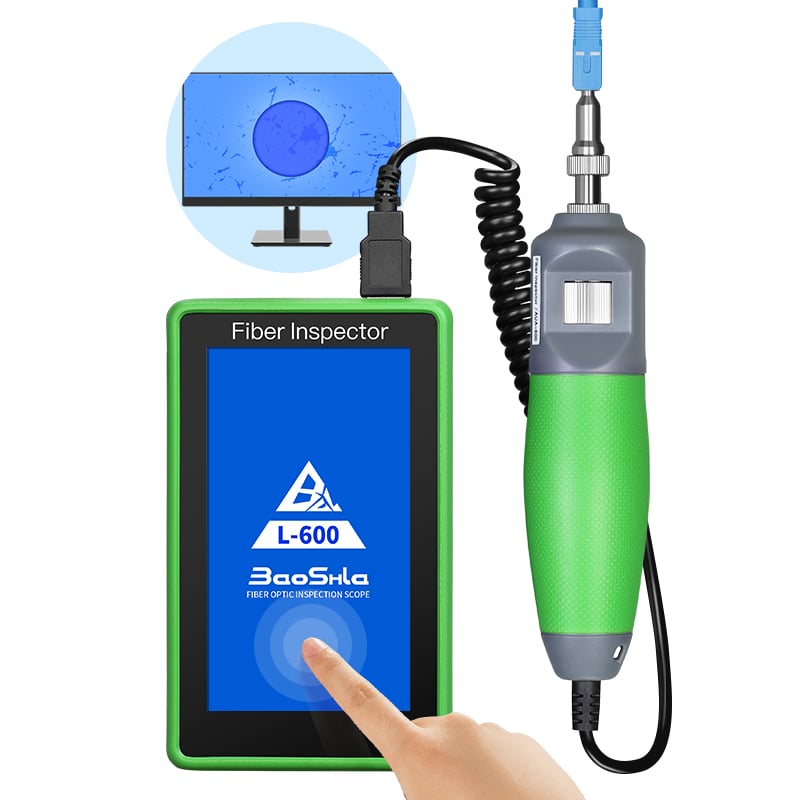
The Fiber End Face Detector operates by using high-magnification optical inspection to visualize connector end faces at scales otherwise invisible to the naked eye. This technology reveals contamination particles, surface damage, geometric irregularities, and alignment problems that directly impact optical signal transmission. By detecting these defects accurately, a Fiber End Face Detector enables preventive maintenance and quality assurance across installation, maintenance, and troubleshooting workflows.
Surface Contamination and Particle Defects
Identifying Dust and Debris
One of the most common issues detected by a Fiber End Face Detector is surface contamination from dust, lint, and airborne particles. These contaminants accumulate on the connector end face and create optical scattering, reducing signal clarity and increasing insertion loss. A Fiber End Face Detector with magnification capacity of 200x to 400x can clearly visualize particles as small as one micron, making it invaluable for identifying contamination before it reaches critical thresholds. Technicians using a Fiber End Face Detector can distinguish between acceptable residual particles and those requiring immediate cleaning or connector replacement.
Oil, Grease, and Organic Film Detection
Beyond dry particles, a Fiber End Face Detector reveals oily films and residual grease left by handling or environmental exposure. These organic coatings are particularly problematic because they absorb light and create a diffused optical path rather than clean reflection. A Fiber End Face Detector displays these films as hazy or cloudy regions across the end face, signaling the need for specialized cleaning protocols. Understanding how a Fiber End Face Detector interprets these patterns helps technicians select the correct cleaning method and verify effectiveness after intervention.
Physical Surface Damage and Geometric Defects
Scratches, Pits, and Micro-Fractures
Physical damage to the connector end face directly degrades signal transmission, and a Fiber End Face Detector is essential for detecting these flaws before deployment. Scratches on the polished surface scatter light and increase optical loss significantly. A Fiber End Face Detector magnifies these surface irregularities, showing their depth, width, and orientation relative to the fiber core. Micro-fractures and pits, invisible to ordinary inspection, become apparent under the magnification power of a Fiber End Face Detector. Such defects may originate from rough handling, improper storage, or manufacturing inconsistencies, and early detection via Fiber End Face Detector prevents them from cascading into network failures.
End Face Geometry and Angle Verification
The geometric shape of the connector end face is critical for achieving proper coupling efficiency, and a Fiber End Face Detector confirms that polishing angles meet specification. Single-mode connectors require precise angle tolerances, typically 8 degrees, and deviations detected by a Fiber End Face Detector indicate either manufacturing defects or installation damage. The magnified image produced by a Fiber End Face Detector allows technicians to assess the curvature and flatness of the polished surface, ensuring optical alignment standards are met. Identifying angle problems early through a Fiber End Face Detector prevents connector pairing mismatches that would otherwise cause return loss and signal reflection.
Core Exposure and Alignment Issues
Fiber Core Visibility and Over-Polish Detection
A Fiber End Face Detector can reveal whether the fiber core is properly centered and adequately protected by the ferrule material. Over-polishing, which exposes or significantly reduces the protective ferrule layer around the core, becomes obvious when viewed through a Fiber End Face Detector. This condition compromises mechanical protection and optical performance, making detection via Fiber End Face Detector critical before field deployment. The contrast between core and ferrule material visible in a Fiber End Face Detector image indicates whether the connector meets industry standards for core exposure limits, typically specified as no more than 0.5 microns of exposed core.
Ferrule Damage and Chipping
The ferrule material surrounding the fiber core can chip or develop stress fractures during handling or thermal cycling. A Fiber End Face Detector reveals these defects as dark lines, cracks, or material loss visible in high-magnification view. Such damage compromises the connector's mechanical integrity and may lead to total failure during insertion or thermal stress. Detection via Fiber End Face Detector enables technicians to quarantine defective connectors before they enter the network. Additionally, a Fiber End Face Detector helps establish baseline images of connector condition at installation, enabling comparison during maintenance intervals to track degradation trends.
Fiber Core Alignment Within Ferrule
Proper alignment of the fiber core within the ferrule concentricity is essential for maintaining signal quality, and a Fiber End Face Detector verifies this relationship visually. Eccentricity or off-center core positioning, sometimes caused by ferrule manufacturing variability or damage, can be detected immediately with a Fiber End Face Detector. When mated pairs of connectors have misaligned cores, signal loss increases dramatically; using a Fiber End Face Detector to inspect each connector individually prevents such problematic pairings.
Practical Application and Quality Assurance Workflow
Installation Quality Control
Field technicians deploying fiber networks routinely use a Fiber End Face Detector to verify connector quality immediately after field termination or splicing. This real-time inspection capability through a Fiber End Face Detector catches installation errors before fiber is sealed into conduit or infrastructure. Quality assurance protocols increasingly mandate connector inspection via Fiber End Face Detector as a non-negotiable step, similar to traditional insertion loss measurements. This proactive approach through Fiber End Face Detector reduces network reliability issues and service call frequency significantly.
Troubleshooting Network Performance Issues
When fiber networks experience unexpected signal loss or intermittent faults, a Fiber End Face Detector provides rapid diagnostic capability by isolating connector-related defects as the root cause. Technicians can systematically inspect every connection point using a Fiber End Face Detector to build a map of defect locations. This systematic approach using a Fiber End Face Detector reduces troubleshooting time and identifies whether defects stem from installation, environmental stress, or age-related degradation.
FAQ
What magnification level do I need in a Fiber End Face Detector to see connector defects clearly?
Most industry standards recommend at least 200x magnification in a Fiber End Face Detector to visualize particles and surface irregularities reliably. Premium models offer 400x magnification, providing even greater detail for comprehensive defect detection. A Fiber End Face Detector with 400x magnification can identify defects as small as 0.5 microns, enabling detection of manufacturing inconsistencies and environmental contamination that lower magnification might miss.
Can a Fiber End Face Detector detect all types of connector defects?
A Fiber End Face Detector excels at detecting surface-level defects such as contamination, scratches, pits, and geometric irregularities. However, internal fiber defects or mechanical stress fractures deep within the ferrule may not be visible in a Fiber End Face Detector image alone. For comprehensive diagnostics, a Fiber End Face Detector should be used in combination with insertion loss measurements and optical time-domain reflectometry (OTDR) testing to identify subsurface or alignment-related issues.
How often should I inspect connectors with a Fiber End Face Detector during network maintenance?
Best practice recommends using a Fiber End Face Detector to inspect connectors at installation, after any maintenance event, and annually on critical network links. Environmental factors such as temperature cycling, humidity, and dust exposure can accelerate connector degradation, making periodic inspection via Fiber End Face Detector essential for long-term network reliability. High-traffic or mission-critical installations may warrant quarterly inspections using a Fiber End Face Detector to detect emerging defects before they cause service interruptions.