 EN
EN
Working with a fiber optic fast connector requires more than careful hands. The tools you use during termination directly determine whether a connection delivers clean signal transmission or introduces loss, reflection, and long-term performance problems. Many installers underestimate how much simple, well-chosen tools contribute to a successful fiber optic fast connector installation. When each tool does its job correctly, the entire termination process becomes faster, more repeatable, and far more reliable on the first attempt.
The fiber optic fast connector is designed specifically for field termination without the need for adhesives, ovens, or polishing equipment. This makes it an appealing choice for contractors, telecom technicians, and network builders who need speed without sacrificing quality. However, achieving a low-loss fiber optic fast connector termination still demands a disciplined approach to tool selection and technique. This article examines the core tools involved, explains their individual roles, and describes how they work together to support consistent termination outcomes across different project types.
The Foundation Tools Every Technician Needs
The Fiber Cleaver and Its Critical Role
The fiber cleaver is the single most important tool in any fiber optic fast connector workflow. Its purpose is to produce a flat, perpendicular end-face on the bare fiber before it is inserted into the connector. A poor cleave introduces an angled or chipped fiber end, which causes light to scatter rather than transmit cleanly. When a fiber optic fast connector receives a badly cleaved fiber, the resulting insertion loss can exceed acceptable limits immediately, even if every other step was performed correctly. A quality cleaver ensures that each fiber end-face meets the geometric standard required by the fiber optic fast connector's internal alignment mechanism.
Not all cleavers are equal, but even a compact, tool-kit-level cleaver can deliver acceptable results when used properly. The key is consistency. Technicians should inspect the cleave visually or with a fiber inspection scope before inserting the fiber into any fiber optic fast connector. Skipping this step is one of the most common causes of repeated retermination and wasted connectors on real job sites.
Fiber Strippers and Coating Removal
Before cleaving, the fiber coating must be removed cleanly using a dedicated fiber stripper. Attempting to strip coating with a blade, nail, or non-dedicated tool often damages the cladding or leaves residue that interferes with the fiber optic fast connector's internal ferrule alignment. A proper fiber stripper removes the coating in a single pass without scratching the glass. This matters because any surface damage introduced during stripping will carry forward through cleaving and into the final fiber optic fast connector assembly, showing up as elevated loss or back-reflection.
Testing Tools That Confirm Termination Quality
The Visual Fault Locator in Field Verification
A visual fault locator, or VFL, is a compact pen-style device that injects visible red laser light into the fiber. When a fiber optic fast connector termination has a high-loss point, a cracked fiber, or a poorly seated end-face, the red light leaks visibly through the connector body or cable jacket. This makes the VFL one of the most immediate and practical tools available for confirming that a fiber optic fast connector has been installed without obvious physical faults. Technicians can use the VFL directly after seating the fiber to check for leakage before moving to the next step or closing up a splice enclosure.
The VFL does not replace insertion loss measurement, but it eliminates gross errors before they become buried problems. In high-volume fiber optic fast connector termination scenarios, using a VFL as a first-pass check saves significant time by catching poor cleaves, broken fibers, or incomplete seating before running full power measurements.
The Optical Power Meter for Loss Measurement
While the VFL identifies visible faults, an optical power meter gives a quantitative measurement of the light reaching the far end of a link. When combined with a calibrated light source, the optical power meter allows a technician to measure the actual insertion loss introduced by a fiber optic fast connector and determine whether it meets the specification for the network. Most fiber optic fast connector products are rated for insertion loss below 0.5 dB when properly terminated. Verifying this in the field, rather than assuming, separates professional installation from guesswork.
An optical power meter with a measurement range suitable for both single-mode and multimode fiber covers the widest variety of fiber optic fast connector applications. Compact meter designs that fit into a toolkit make this kind of in-field measurement practical even in confined spaces, overhead cable trays, or outdoor enclosures where larger test sets would be impractical.
How Simple Tools Work Together in a Real Termination
The Workflow Logic That Connects Each Tool
The real value of simple tools in fiber optic fast connector work comes from how they form a logical sequence. Each tool addresses one specific risk in the termination process. The fiber stripper eliminates coating damage risk. The cleaver eliminates end-face geometry risk. The VFL eliminates gross physical fault risk. The optical power meter eliminates unverified loss risk. When a technician follows this sequence for each fiber optic fast connector, the probability of a failed link drops dramatically compared to ad-hoc tool use or relying on experience alone.
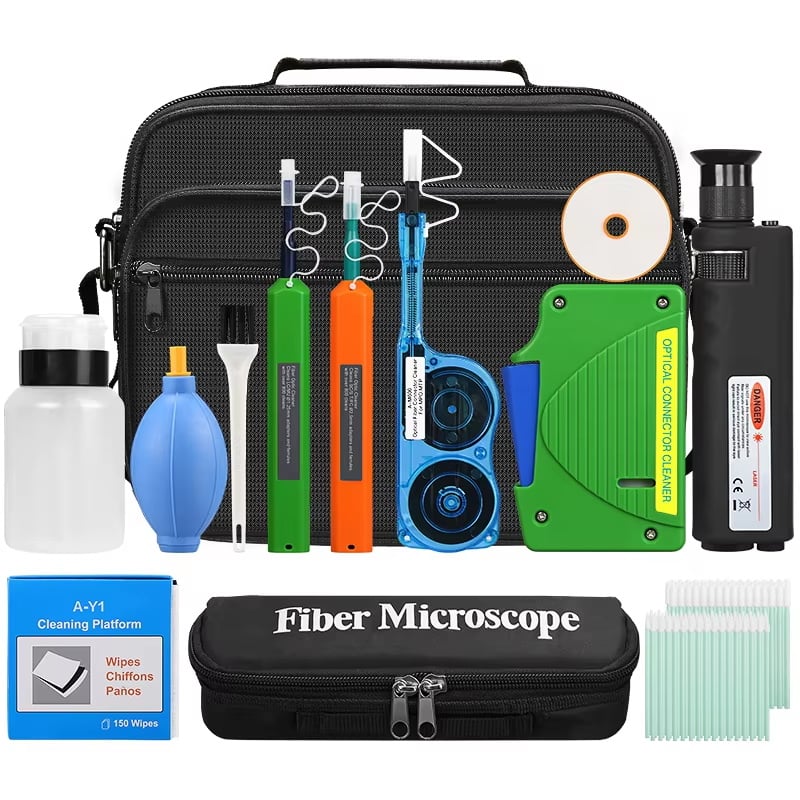
Many kits designed specifically for fiber optic fast connector termination bundle these tools together in a compact carrying case. This packaging is not coincidental. It reflects how these tools function as a system rather than as independent utilities. A fiber optic fast connector kit that includes a cleaver, stripper, VFL, and power meter puts the entire quality workflow in a single portable unit, making structured termination accessible even for field teams working without a permanent workshop.
Maintaining Tool Condition to Protect Results
Even the best fiber optic fast connector termination technique can be undermined by worn or dirty tools. Cleaver blades become dull with repeated use and produce progressively worse end-faces. Stripper blades that develop nicks can score the fiber cladding. VFL outputs weaken over time if the laser source degrades. Keeping tools clean, calibrated, and replaced on schedule is part of professional fiber optic fast connector practice. A worn cleaver used on ten fiber optic fast connector terminations may cause failures on the last three that would never have occurred with a fresh blade.
FAQ
Can I terminate a fiber optic fast connector without a dedicated cleaver?
Technically possible in emergency conditions, but not recommended. A fiber optic fast connector relies on a precise end-face to achieve low insertion loss. Without a proper cleave, most fiber optic fast connector terminations will exhibit unacceptable loss, and the connector will likely need to be replaced. A dedicated cleaver is the most cost-effective way to ensure repeatable results.
How often should I verify a fiber optic fast connector with a power meter?
Every fiber optic fast connector termination should be verified before the link is commissioned. Using a VFL for a first-pass check followed by an optical power meter for a final loss measurement gives full confidence that each fiber optic fast connector meets its specification. Skipping measurement and assuming the termination is good introduces risk that typically surfaces as network faults later.
Is a fiber optic fast connector kit suitable for both single-mode and multimode fiber?
Most fiber optic fast connector kits support both fiber types, but you must confirm that the specific connectors, cleaver settings, and optical power meter wavelengths match the fiber type you are working with. Single-mode and multimode fiber optic fast connector products have different ferrule geometries and performance specifications, so matching the kit components to the fiber type is essential for achieving rated insertion loss.