
 EN

Arc calibration in a fusion splicer represents one of the most critical maintenance and setup procedures in fiber optic splicing operations. Proper calibration of the fusion splicer directly determines whether your splice joints achieve minimal loss and maintain structural integrity over decades of deployment. When arc calibration drifts even slightly, splice loss increases dramatically, and the longevity of the connection suffers, potentially leading to costly field interventions and network downtime. Understanding how fusion splicer calibration impacts both immediate splice quality and long-term fiber reliability is essential for telecom professionals, data center operators, and fiber deployment teams.
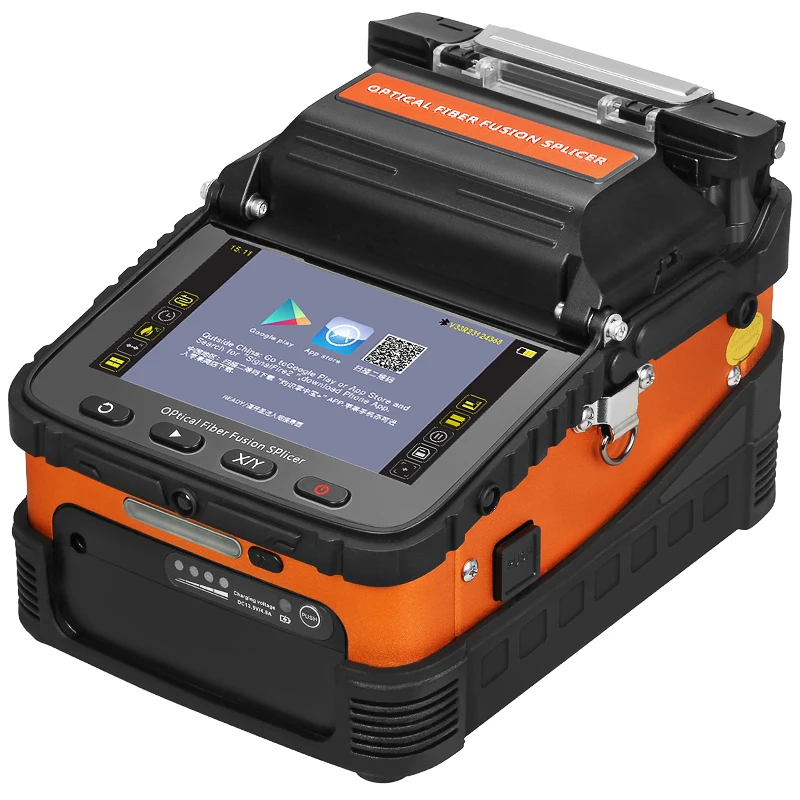
A fusion splicer works by using an electric arc to melt and fuse two fiber optic strands together at their cores, creating a permanent joint. The quality of this fusion process depends entirely on precise arc calibration, which controls arc strength, duration, heating pattern, and electrode positioning. When your fusion splicer lacks proper calibration, the arc may be too weak to fully fuse the fibers, leaving microscopic voids and stress points, or too strong, causing core deformation and scattering loss. This article explores the technical mechanisms linking arc calibration to splice loss and fiber longevity, examines how calibration drift occurs in field conditions, and provides actionable guidance for maintaining optimal fusion splicer performance throughout its operational life.
Understanding Arc Calibration in Fusion Splicer Systems
The Role of Arc Parameters in Splice Quality
Every fusion splicer employs a calibration routine that measures and adjusts the electric arc's strength and timing. The arc calibration process in a modern fusion splicer typically involves measuring the actual arc voltage and current produced, then comparing these values to factory reference standards. If the fusion splicer's measured arc parameters drift from specification, the splicing control unit automatically adjusts electrode spacing or power output to restore correct arc behavior. This continuous feedback loop ensures that each splice performed by the fusion splicer receives consistent thermal energy in the precise pattern needed for optimal fiber fusion without core damage.
When arc calibration is accurate, the fusion splicer produces a tight, homogeneous joint where the fiber cores merge seamlessly. The result is typical splice loss in the range of 0.03 to 0.1 dB, depending on fiber type and alignment precision. However, even minor calibration drift in a fusion splicer—such as a 5% reduction in arc strength—can increase splice loss to 0.2 to 0.5 dB or higher. This loss increase happens because the weaker arc fails to completely fuse the core material, leaving stress concentrations and refractive index discontinuities that scatter light.
Calibration Drift and Field Degradation
Arc calibration in a fusion splicer degrades over time due to electrode erosion, dust accumulation on optical surfaces, and changes in atmospheric pressure at deployment altitude. Electrodes in a fusion splicer are consumable components that ablate with each splice cycle, subtly changing the arc geometry and requiring periodic recalibration. Environmental factors also affect how a fusion splicer performs; high humidity can alter the ionization pathway in the arc chamber, while temperature fluctuations change electrode resistance and arc initiation voltage. Field technicians often underestimate the importance of regular arc calibration checks on their fusion splicer, viewing it as optional maintenance rather than a scheduled requirement tied to splice count or elapsed time.
Direct Impact on Splice Loss Mechanisms
Loss Sources Stemming from Poor Arc Calibration
Splice loss arises from multiple physical mechanisms, and improper arc calibration in a fusion splicer directly causes or worsens most of them. Intrinsic loss occurs when the fiber cores do not perfectly align, a problem that fusion splicer alignment motors can help correct, but arc calibration affects core fusion quality independent of alignment. When a fusion splicer arc is too weak, the melted silica doesn't flow uniformly into the gap between fibers, leaving microcracks or voids that act as internal reflection boundaries and scatter light. Extrinsic loss results from core mode field diameter mismatch, stress-induced birefringence from incomplete fusion, and refractive index anomalies that develop when the fusion splicer arc energy is insufficient.
Radiation loss, another critical component, increases when the arc in a fusion splicer fails to create a uniform, stress-free joint. The cladding region near the splice point contains residual stress when a poorly calibrated fusion splicer produces an incomplete fusion, and this stress modifies the local refractive index profile. Light guided in the core begins to couple into cladding modes, where it radiates away and is lost from the signal. A well-calibrated fusion splicer minimizes stress by delivering optimal arc energy that fully anneals the fused region, allowing the joint to relax into a low-stress, mechanically sound configuration.
Cumulative Loss Impact in Long-Distance Links
In long-distance fiber optic networks, dozens or hundreds of splices may exist along a single span. If each splice produced by an improperly calibrated fusion splicer adds 0.2 dB instead of 0.05 dB, the cumulative effect becomes severe. A 100-splice link might experience 20 dB of additional loss compared to the same link spliced with a properly calibrated fusion splicer, completely overwhelming the receiver sensitivity margin. This loss accumulation forces network operators to deploy additional amplifiers or regenerators, increasing capital expenditure and operational complexity. Regular arc calibration of the fusion splicer prevents this creep, ensuring that splice loss remains predictable and within link budget calculations.
Longevity and Mechanical Reliability Implications
Thermal Stress and Mechanical Fatigue
The longevity of a splice joint depends not only on optical properties but also on mechanical strength and resistance to environmental stress. When a fusion splicer arc is poorly calibrated, the resulting splice contains internal thermal gradients and residual stress that make it vulnerable to fatigue fracture under vibration or thermal cycling. A fusion splicer that delivers inadequate arc energy creates a joint with uneven stress distribution, where weak regions experience stress concentration and initiate cracks during normal cable handling or seasonal temperature swings. Over months or years, these micro-cracks propagate, eventually leading to splice failure and fiber breakage in the field.
Conversely, a fusion splicer with properly calibrated arc delivers uniform, controlled thermal energy that allows the joint to cool and anneal uniformly. The resulting microstructure is homogeneous and free from the sharp stress discontinuities that cause premature failure. Field studies consistently show that splices made with a well-maintained, accurately calibrated fusion splicer survive 25+ years in harsh outdoor environments, while poorly calibrated splices may fail within 2 to 5 years under similar conditions.
Environmental Resilience and Reliability Assurance
Fiber optic cables deployed in demanding environments experience temperature swings, moisture ingress, and mechanical stress that test splice integrity continuously. A fusion splicer that produces low-loss, stress-free joints provides environmental resilience because the uniform microstructure resists moisture-assisted stress corrosion cracking in the silica glass. The protective role of arc calibration becomes apparent when comparing field failure rates; operators using properly calibrated fusion splicer equipment report splice survival rates exceeding 99.9% over 20 years, while those with drift-prone equipment see failure rates of 0.5% to 2% annually. Arc calibration in a fusion splicer thus represents a direct investment in network reliability and operational longevity, reducing the need for emergency repairs and extending the economic life of deployed fiber infrastructure.
FAQ
How often should I calibrate my fusion splicer arc?
Most manufacturers recommend running full arc calibration on your fusion splicer at the start of each work day and after every 500 to 1000 splices, depending on the specific model and environmental conditions. If your fusion splicer operates in high-humidity, high-altitude, or high-temperature environments, increase calibration frequency to every 300 to 500 splices. Field technicians should also perform a quick arc calibration check if they notice splice loss creeping above normal ranges or if several weeks elapse between deployment projects.
Can poor arc calibration in a fusion splicer be detected before splicing?
Yes, most modern fusion splicer units include arc test functions and calibration status displays that alert the operator to calibration drift before it affects splice quality. A fusion splicer will typically display a warning or alarm if arc parameters fall outside acceptable ranges. However, some older fusion splicer models lack real-time diagnostics, so operators must rely on periodic manual calibration routines and observation of splice loss trends to detect drift. Using an optical time-domain reflectometer (OTDR) to measure splice loss in real time provides independent confirmation that your fusion splicer is performing within specification.
Does arc calibration affect the splice strength rating?
Yes, arc calibration directly affects both optical and mechanical performance of the splice joint. A fusion splicer with accurate arc calibration produces splices that meet or exceed the fiber's ultimate tensile strength rating, typically 100 kpsi or higher for standard single-mode fiber. Conversely, a poorly calibrated fusion splicer may produce joints with 30% to 50% lower tensile strength due to incomplete fusion and residual stress concentration. When splice strength falls below the fiber strength, the joint becomes the weakest link in the cable assembly and fails first under mechanical stress, even if optical loss remains acceptable.